Powerdynamo brings new ignition & light
to your vintage motorcycle



|
|
Powerdynamo brings new ignition & light |
|
|||
|
|
|||||
|---|---|---|---|---|---|
| Assembly instructions for System 70 63 799 00 |
Version 10.02.2010 |
|
If you can install and time a stock ignition and
possess basic mechanical skills, you can install a Powerdynamo! |
|
| Powerdynamo can not monitor the compliance to those instructions, nor the conditions and methods of installation, operation, usage and maintenance of the system. Improper installation may result in damage to property and possibly even bodily injury. Therefore we assume no responsibility for loss, damage or cost which result from, or are in any way related to, incorrect installation, improper operation, or incorrect use and maintenance. We reserve the right to make changes to the product, technical data or assembly and operating instructions without prior notice. | |
|
|
Please read these
instructions fully and carefully before starting work on your motorcycle Please bear in mind that any modification of the material as well as own repair attempts which have not been agreed with Powerdynamo may result in a loss of warranty. Do not cut off wires. This leads to a loss of reverse polarity protection and often results in damage to electronics. Also, please take note of the information provided on the information page for this system. Check that what you have bought really corresponds to the motorcycle you have. Wrong ignition settings may damage your engine and even hurt you during kickstart (violent kickbacks). Be careful during the first test runs. If needed change settings to safer values (less advance). During assembly check carefully that the rotor (flywheel) does not touch the stator coils or anything else, which may happen due to various circumstances and lead to severe damage. |
| Designated use This system is designated to replace stock dynamo/alternator & ignition systems in vintage and classic motorcycles whose engine characteristics have not been modified aftermarket. This system is not a tuning system and it will not bring significant increases in engine output. It does however significantly enhance roadworthiness and comfort by offering better lighting, better function of side indicators and horn and, compared with the aging stock systems, increased reliability. As our system does not tamper with engine characteristics it does not increase emission of gaseous pollutants and noise. In most cases emission of pollutants should even be reduced due to better combustion. If used as designated the system therefore will not normally infringe the existing legal status of the motorcycle (this statement is valid for Germany, for other countries, please check locally against your road licensing regulations). This system is not suitable for use in competition events. If used other than the designated way, warranty will be voided and it might well be that you do not obtain the desired results or, worst you loose legal roadworthiness. The charging system is only suitable for use with rechargable 12V (6V systems 6V) lead-acid batteries with liquide electrolyte or sealed lead-acid batteries, AGM, Gel. It is not suitable for use with nickel-cadmium, nickel-metal-hydride, lithium-ion or any other types of recharchable or non rechargable batteries. This is a replacement system and not a copy of the stock material. The parts in this system therefore look different and might fit differently (notably ignition coil and regulator) requiring some adaptation by you. |
|
| During assembly imperatively start with assy of engine based parts to see that those really fit before you start fitting the external parts. In many cases customers assemble those first and thereby often modify them in breach of warranty which renders them unfit for renewed sale. Replacing old ignition systems is not a matter of taking something from a supermarket shelf as there have been very many types, versions and possibly unknown aftermarket modifications which harbour plenty of room for error. | |
| Our systems are NOT tested for use with third party electronic devices (such as GPS, mobile phones, LED lighting etc)and may cause damage to such parts. Possibly existing electronic tachometers will not work with the new system. Read our information for suitable solutions. Possibly existing safety switches and electronic valve controls are not supported. It might be that your motorcycle was originally equipped with an ignition that did limit top speed for legal reasons. The new system does not have such a facility, so check your legal situation beforehand. | |
| If you have no expertise for the installation have it done by an expert or at a specialist's workshop. Improper installation may damage the new system and your motorcycle, possibly even lead to bodily harm. | |
| Before you order a system, please check whether a puller
tool for the new rotor is included in the kit. If not,
better order it at the same time. You might want to order light bulbs,
fuse, horn,
flasher
unit etc. Never use anything other than the recommended puller tool to pull the new rotor again. Damage to the rotor as a result of use of other tools or methods is not covered by warranty. |
|
| The rotor is sensible to blows (including during transport). Before assembly, please always check for damage (on rotor without magnet plastification try to push the magnets aside with your fingers). After impact the glued in magnets might have broken loose, sticking to the rotor solely by magnetic force, so that one does not notice right away. During engine run the damage would be considerable. Before placing the rotor onto the engine, please make sure that its magnets have not collected any metal objects such as small screws, nuts and washers. That equally would lead to severe damage. | |
|
|
If you have access to the Internet, best view those instructions online. You get larger and better pictures by clicking onto them and possibly updated information. System list at http://www.powerdynamo.biz |
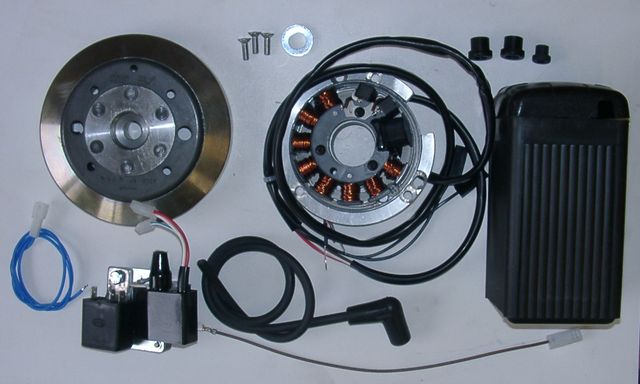 |
You should have received those parts! |
|
|
|
| Make sure your
bike rests securely on her stand, preferably on an elevated work
bench and that you have good access to the generator side of the engine.
Disconnect your battery and take it out of the motorcycle. Note that should you be installing a 12 volt system, you will either need a 12 volt battery or you use the option of driving without. You will still have to replace all lightbulbs to 12 volt ones however in that case too. The horn may stay at 6 volts. For driving without battery, please observe our information on driving without battery. |
|
|
|
|
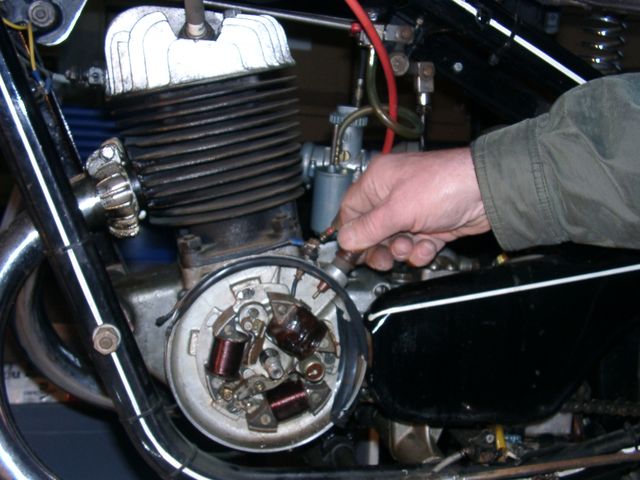 |
Disconnect the cables from your old generator and remove it. Remove the contact
holder (bakelite) from the ignition cable.
Unscrew the old stator and take it off the engine. Pull the rotor off, you will need a puller screw for this. Take the woodruff key from the crank. You will not need it any more. Please do not forget to do so, otherwise you will have trouble later on the assembly. (Remark: This woodruff key does not actually hold your rotor on the shaft, this is done by the cone. It simply guides to the correct setting which will now be otherwise achieved.) |
|
|
|
|
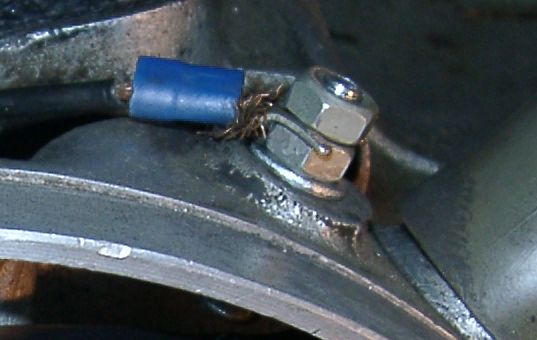
Insert a screw M5x25 from the inside in the hole, where previous the
power cable were connected. Bolt it together with 2 nuts M5. You can
fasten here a "dummy-cable" (maybe a additional ground cable).
Anyway, there is no power on this point.
Take care of the cable that goes to the lamp, you will need it later (see below). |
|
|
|
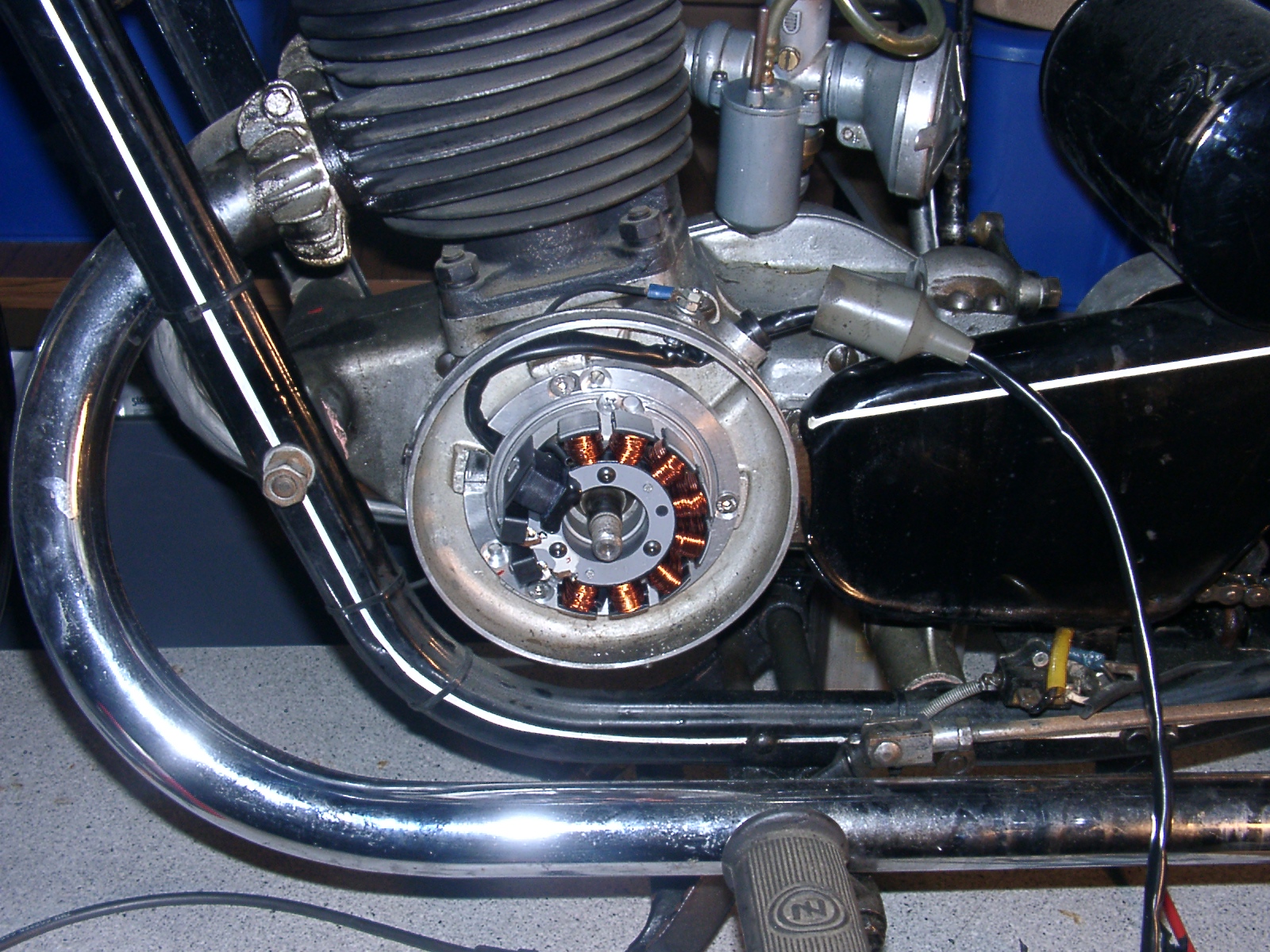 |
Now mount the new ground plate (with the coil), using the
original mounting holes, on the crank case and screw it tight.
The thick black coil shows at 10 o'clock. Screw down the unit with the 2 hex countersunk bolts M5x16. |
|
|
|
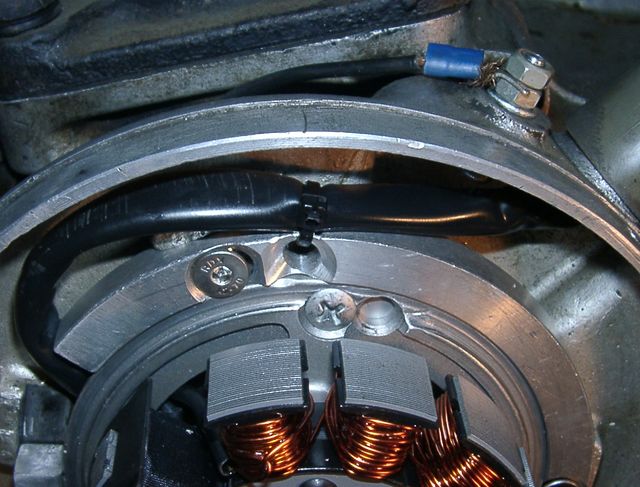 |
Lead the stator cable through the ignition cable hole
out of the case.
To preserve the cable against damaging of the rotor, you have to fasten the cable to the stator ground plate with a cablefixer. Use the bore hole beneath the upper mounting (see picture). |
|
|
|
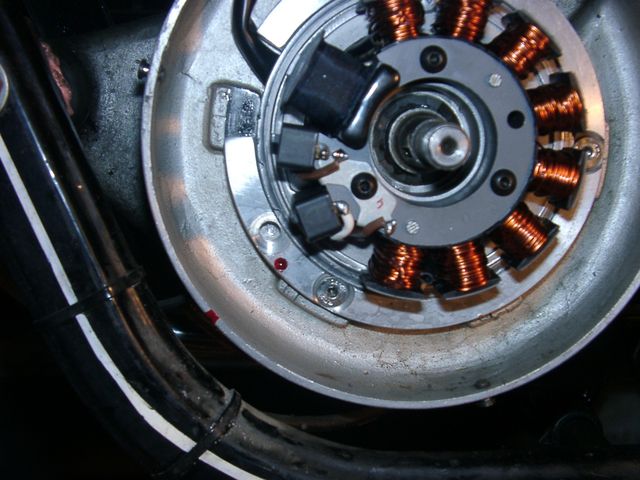 |
Have a look at the ground
plate. There you will find about half past 7 a red point marker.
After put on the rotor, is this ignition marking not visible. You have to transcribe it to the case, maybe with a file and a pen. (see picture) |
|
|
|
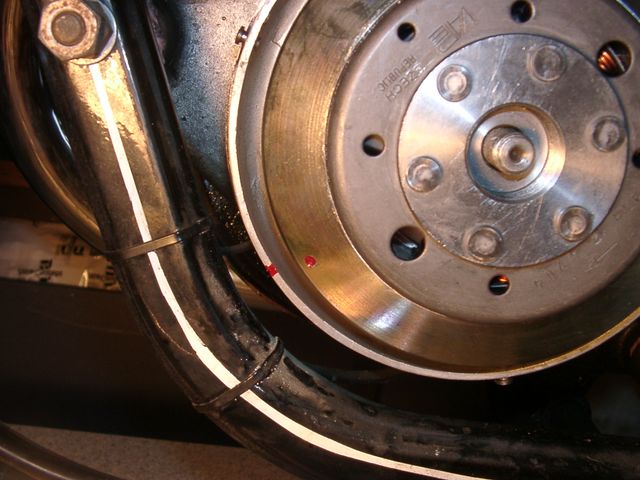 |
Have a look at the new rotor. You will find on its circumference a red point
marker. This is an ignition marking too.
Both have to align at the point of ignition. |
|
|
|
|
Remove the spark plugs. Place the rotor loosely onto the crank and check that it may move freely
above the statorbase.
Please pay attention: The fields spider is turning anti clockwise. That means, you have to turn it clockwise (from TDC). |
|
|
|
|
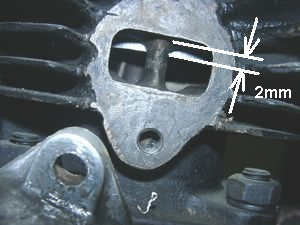 |
In case of the obliquely spark plug, it is
difficult to find the TDC. You should have to remove the carburettor
manifold from the cylinder. You may see the piston through the opening.
The piston stands at TDC, if the lower edge of the piston is 1.5mm over
the upper edge of the "window". If you see the piston 4mm (see
picture), is it the right measure (5.5mm BTDC). It's difficult to
measure here, but you should have to appraise. It's not the matter of
0.5mm.
If you want to make it accurate, you have to remove the tank and the cylinder head. It's not worth it. |
|
|
|
| For maximal flexibility of the ignition alignment, we don't have adapted the rotor to the crank shaft with the woodruff key and the notch. But there is no danger of loosen or distortion of the rotor. The rotor was always kept by the cone, never by the woodruff key. You will miss it yet for that time, that you have to fasten the rotor on the crank shaft, without changing the position of both. At this time is a second person, who observe the piston from the other side and inform you about every change immediately, such as good as gold. | |
|
|
|
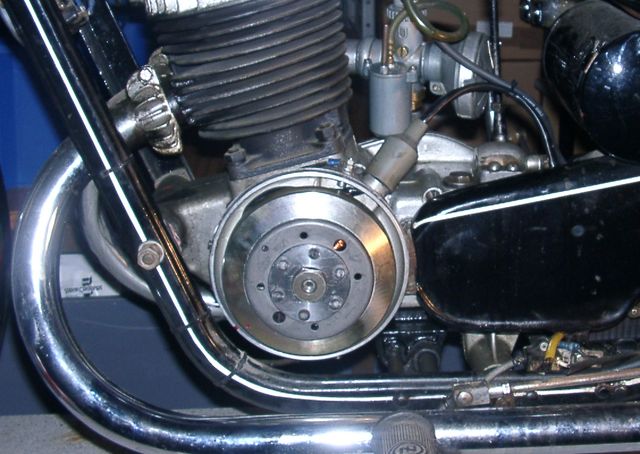 |
Put the new rotor handtight on the crank shaft for
turning the shaft (clockwise).
Bring the piston into ignition position. Might
be 5.5mm BTDC.
Take the rotor carefully off again without changing the crank's position. Reset it onto the crank in such a way that the marking on the rotor aligns with the marking on the stator. In that position fasten the rotor carefully with the original nut. (Please don't forget to use the thick washer.) After that check the piston position. If there is any (big) change in the crank's position, you have to start again. |
|
|
|
| Now the wiring: It is possible, that there are some differences on your CZ in relation to our description. Who knows what happens with the electric since 1936/37. | |
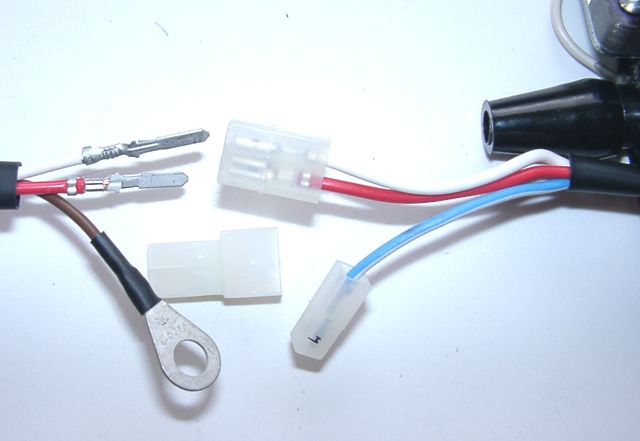 |
To facilitate wire exit from the engine, the plastic plug at the end of
the stator wire is not set yet at time of delivery.
You will have to insert the wire-end-terminals into the plastic plug, paying attention to their position there.
The brown cabel with the round-eye terminal goes to the ground of the ignition coil. |
|
|
|
| The CZ drives originally with AC- and DC-Power. AC for the driving light. DC for charging the battery, the horn and the parking light. | |
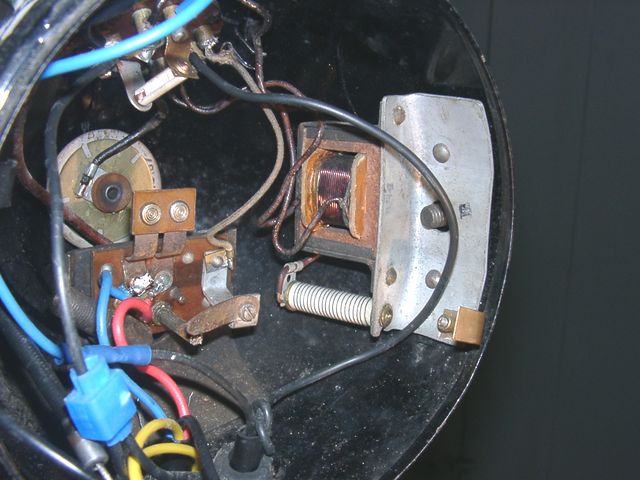
|
From the generator (the cable over the current collector contact) came AC.
This cable goes in the lamp to the switch. From this point (position
"main light") to the headlight and to the rectifier (the round
part with the arrow).
You have to cut-off the connection to the rectifier (securely cut through both cables). The throttle coil (right side of the picture) had some kind of regulating function, to prevent to burn through of the bulbs. The throttle may stay. |
|
|
|
|
You remind of the screwed-off power cable from the generator, that is now
placed by an "dummy cable". You have to connect this screwed-off
cable with the previous plus cable of the battery. (It makes sense to lay
there new cables.) The connection of both cables have to lead to the empty
battery case and will be connected there with the new regulator.
(see below) |
|
|
|
|
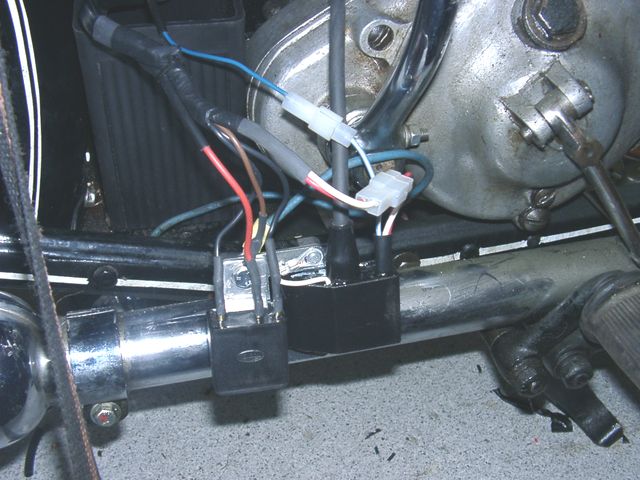
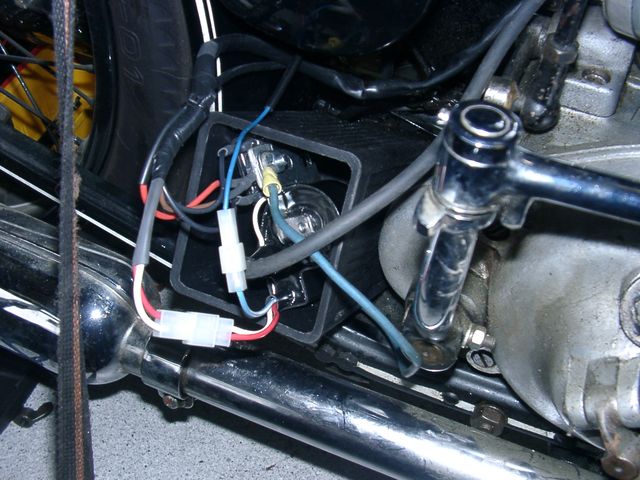
| Fasten the cables at the pre-assembled ignition coil/regulator unit as shown following. | |
|
|
|
|
|
|
|
|
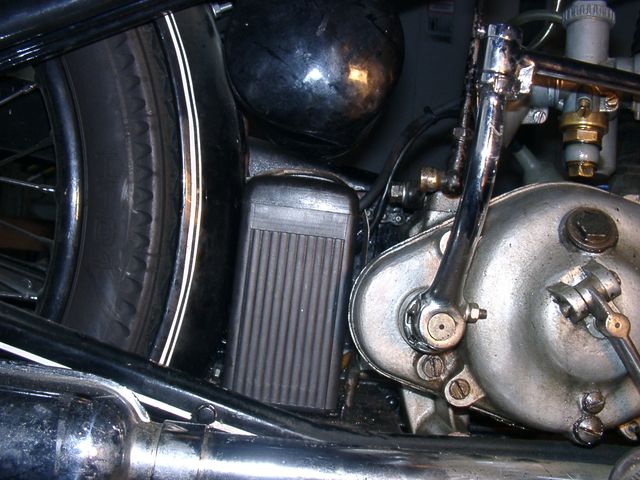
Put the unit in the empty battery case.
Now you have to put the battery case to the original place. It's some fidgeting, CZ was stingy with room here. You will be happy, you don't have to handle no more with the battery. |
|
|
|
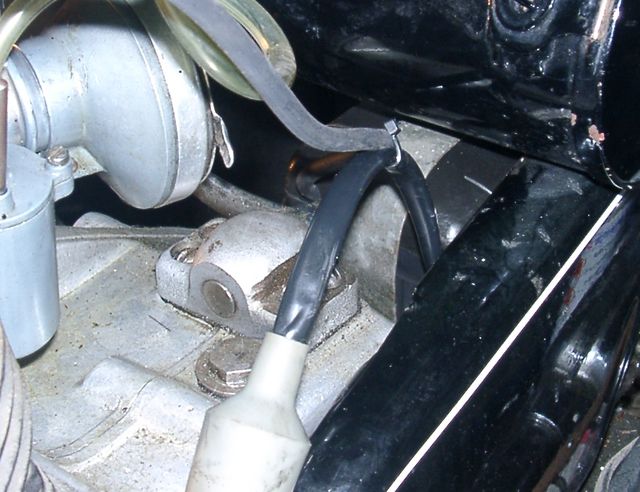
|
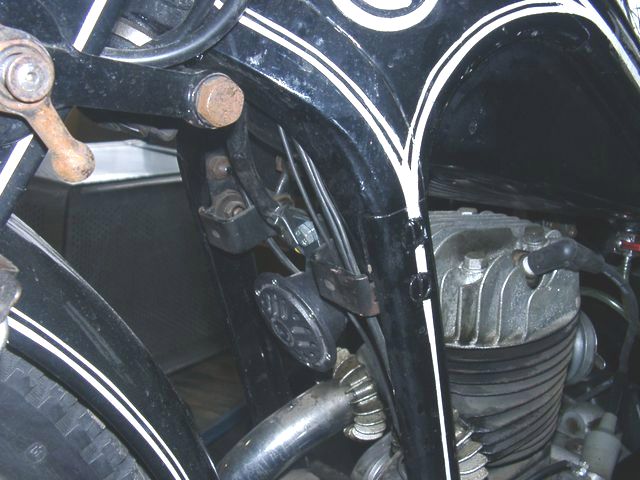
Fixing the cables on their way to he "battery" with cable fixers. |
|
|
|
|
Last, but not least: You have to replace the horn against a DC-horn. It sounds not pretty, but loud. (The DC-horn wouldn't say a word!) |
|
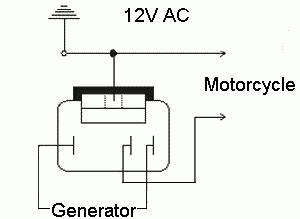
Connect the parts as shown in wiring diagram 71ik-ac: |
||
|
* |
To facilitate wire exit through the often small openings in the engine casing, the plastic plug of the generator's wiring that leads to the ignition coil have not been put onto the wire terminal. You should place the plug there only once all has been properly installed on the engine side. | |
|
|
Look for the ignition coil with its female plug and the two wires (red and
white).
Put the provided 2-position plug housing onto this plug and insert the two wires (red and white) from the generator. Make sure that the terminals engage securely in the housing and that you connect:
|
|
|
Should you need (or want) to get the terminals out of the plug housing again, enter a paper clip from front next to the terminals and push the little barb aside. Than pull the wire out. |
||
|
The brown wire from the new generator with the round eye
terminal has to be screwed directly to the holder frame of the ignition coil (ground). |
||
|
* |
|
The two black cables
leading from the new generator ...
... connect to the outer pins of the new regulator. It does not matter which wire connects to which of the 2 terminals as they carry alternating current. |
| Additional you need to contact a ground wire ... |
... to the metal holder of the regulator. Otherwise the light won't function. |
|
| The middle terminal of the regulator ... |
... will be connected to the wires for the lighting system of the motorcycle. |
|
| * |
Remains the blue (sometimes blue/white) wire at the ignition coil. This is the kill (cut-off) wire.
Note: |
Connected to ground - it
will stop ignition!
This type of wiring is used in motorcycles which originally already had magneto ignition and therefore switched off by shortcircuiting against ground. Those vehicles have by design a main lock (or some kill switch) that connects a pin to ground when in OFF position (German bikes: pin 2). The blue(/white) wire of the ignition coil will be connected here. In that way the cut-off works like previously. |
| * |
Screw the high tension (ignition) cable ...
Please do not use any spark amplifying cables, such as "Nology supercables" or "hot wire". This will disturb the system and possibly damage it. |
... into the ignition coil and pull over the rubber seal before
mounting the
coil (it will be easier).
Please do use the cable arriving with the pack and not any old cable. |
|
You will do yourself a favour to treat your bike to new spark plugs and
spark plug sockets (preferably some between 0-2kOhm).
Plenty of problems are to be traced back to "apparently good" (even
completely "brand-new") sparks plugs, terminals and cables. Do not use spark plugs with an intern suppression resistor. NGK (e.g.) offered such spark plugs coded with an "R" (for resistor). |
||
|
* |
Finally - and before the first kickstart - please re-check carefully all connections and fitments against the wiring diagram. Do check light bulbs for correct voltage (12V). Should something not work, please consult our trouble-shooting guide on our homepage. As a first step disconnect the blue wire from the coil and re-test. |
|
| * |
IMPORTANT: During crank shaft repair the dynamo shaft is often
machined and gets shorter. The result is a rotor sitting lower, possibly
touching now with its rivets the stator coil. The result is a destroyed
stator and ignition failure. For more details and how to check see (online) here. |
|
|
Important safety and operating information for alternating current (AC) only systems |
| Practically, the DC regulator (rectifier/regulator) is the
better solution. It will take higher loads and is more versatile
in use.
The advantage of the AC regulator is in its smallness. This comes in handy in:
|
|
 This
advantage however goes hand in hand with a series of
disadvantages (with possibly
even legal implications) of the AC
regulator! This
advantage however goes hand in hand with a series of
disadvantages (with possibly
even legal implications) of the AC
regulator!
|
|
|
|
Important safety and operating information |
|
# |
Safety first! Please observe the general
health and safety regulations motor vehicle repair (MVR)
as well as the safety information and obligations indicated by the
manufacturer of your motorcycle. The timing marks on the material are for general guidance only during first installation. Please check after assembly by suitable means (stroboscope) that settings are correct to prevent damage to the engine or possibly even your health. You alone are responsible for the installation and the correctness of settings. |
|
# |
Ignition systems generate high tension! With our
material right up to 40,000 Volts! This may, if handled carelessly, not
only be painful, but outrightly dangerous.
Please do keep a safe distance to the electrode of your spark plug and
open high tension cables. Should you need to test spark firing, hold the
spark plug socket securely with some well insulating material and push
it firmly to solid ground of the engine block. Never pull sparkplug caps when engine is running. Wash your vehicle only with engine at standstill and ignition off. |
|
# |
Should you have received in the kit HT cables with a fixed rubber boot(which does not contain a resistor) you might have to use spark plugs with an inbuilt resistor (or replace the cap with one containing a resistor) to comply with your local laws. |
|
# |
After installation, please check tightness of all screws, even those preinstalled. If parts get loose during run, there will be inevitably damage to the material. We pre-assemble screws only loosely. |
|
# |
Give the newly installed system a chance to work, before you start
to check and test values, or what is worse apply changes to it. Our parts have been checked before delivery to you. You will not be able to check much anyway. At any rate do refrain from measuring the electronic components (such as ignition coil, regulator and advance unit). You risk severe damage to the inner electronics there. You will not get any tangible results from the operation anyway. Bear in mind that also your carburetor, your spark plugs and spark plug sockets (even if completely new) might be the reason for malfunction. The general experience with our systems is that the carburetor will have to be re-adjusted to lower settings. Should the system not start after assembly, first disconnect the blue (or blue/white) cut-off wire directly at the ignition coil (or in some cases advance unit) to eliminate any malfunction in the cut-off circuitry. Check ground connections carefully, make sure there is a good electrical connection between frame and engine block. In case of troubles, please consult our Knowledge Base first before you send off the material to us for checking |
|
# |
The spark of classic, points based ignition systems has with about 10,000 Volts comparatively little energy and looks therefore yellow and fat (which however makes it highly visible). The spark from our system is a high energy spark with up to 40,000 Volts and therefore is needle thin focused in form, and blue in colour, which makes it not so visible. Furthermore you get spark only at kick-start operated speeds and not by pushing the kick-lever down slowly with your hand (as you might get with battery based ignitions). |
|
# |
Systems using a twin outlet ignition coils have a few peculiarities. Please observe that during tests on one side, the other has either to be connected to an fitted spark plug or securely earthed/grounded. Otherwise there will be no spark on either side. Also with such open exits long and dangerous sparks may fly all over the coil. |
|
# |
Never do electric arc welding on the bike without completely disconnecting all parts containing semiconductors (ignition coil, regulator, advance) stator and rotor need not be taken off. The same is true for soldering. Before touching electronics disconnect the soldering iron from mains! Never use copper putty on spark plugs. |
|
# |
Electronics are very sensitive to wrong polarity. After work on the system, do check correct polarity of the battery and the regulator. Wrong polarity creates short circuits and will destroy the regulator, the ignition coil and the advance unit. As a rule, wiring will always be colour to colour. Instances, where colour jumps between wires are expressly mentioned in our instructions. |
|
# |
When you handle the new rotor, take care not to damage its magnets. Refrain from direct blows to the circumference of the rotor. When transporting never put the rotor over the stator. Observe our information relative to transport of the material. |
|
# |
Do not use spark plug sockets with a resistance of more than 5kOhm. Better use 1 or 2kOhm ones. Bear in mind that spark plug sockets do age and thereby increase their internal resistance. Should an engine start up only when cold, a defective spark plug socket and/or spark plug is very probably the cause. In case of problems check high tension cables too. Never use carbon fibre HT-cables, never use so called "hot wires" which promise to increase spark. |
|
# |
It is a good idea to cover the rotor in a thin layer of oil to reduce the risk of corrosion. |
|
# |
Never use a claw puller or a hammer to disengage the rotor. Its magnets might become loose in the event. We offer a special puller for disengaging the new rotor again (see assembly instruction)! |
|
# |
Should the motorcycle not be in use for some longer period, please disconnect the battery (so existing) to prevent current bleeding through the diodes of the regulator. Though, even a disconnected battery will empty itself after a while. |
|
# |
Please do observe these remarks, but at the same
time, don't be afraid of the installation process. Remember, that before you, thousands of
other customers have successfully installed the system. Enjoy driving your bike with its new electric heart! |
|
|